
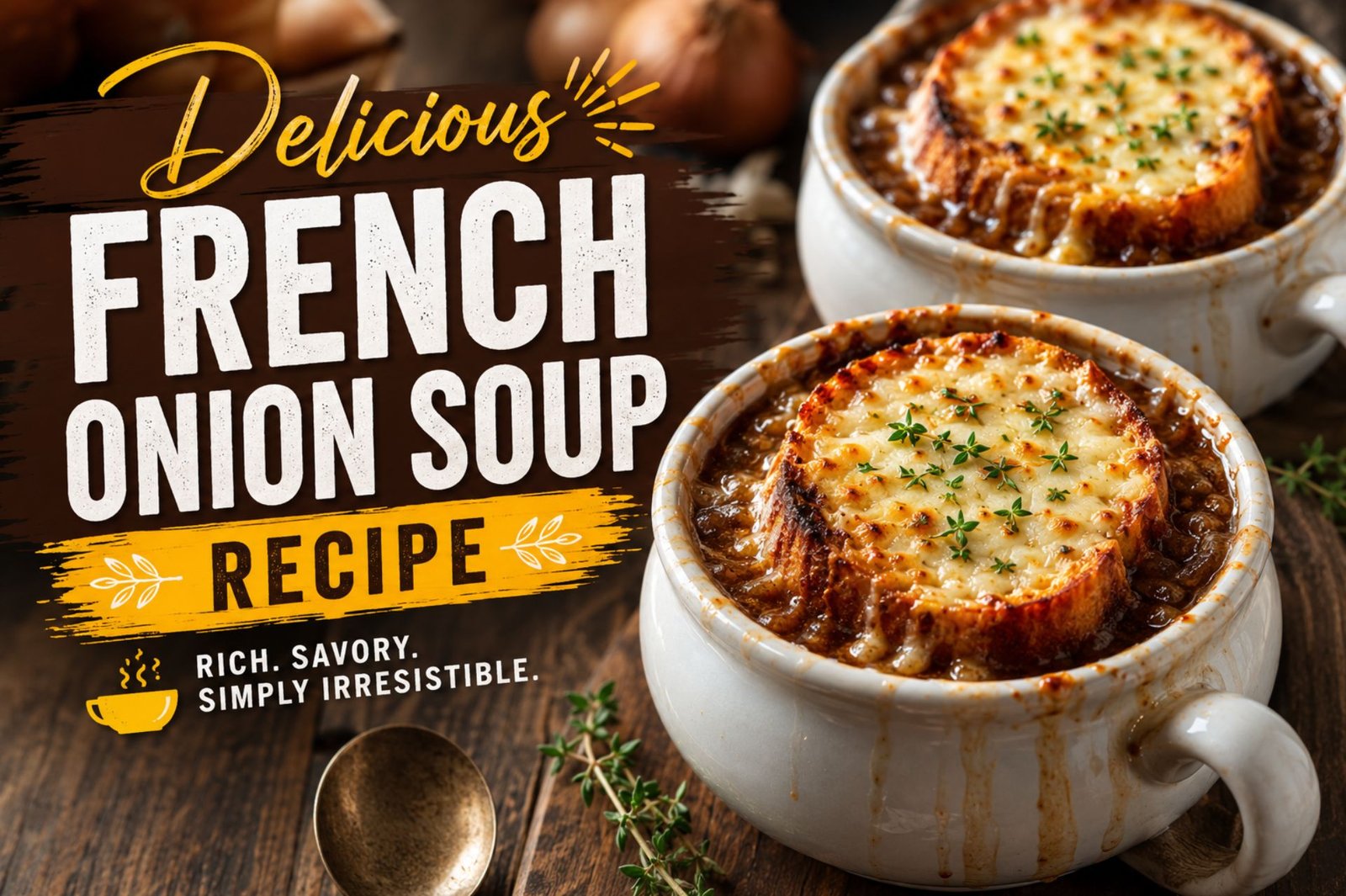
The Best Authentic
French Onion Soup
Deep amber onions, a wine-laced broth, and a lid of molten Gruyère — the recipe that finally explains why this humble soup became a legend, and exactly how to get it right at home.
There’s a reason French onion soup shows up on nearly every bistro menu in the world — and a reason so many home versions fall flat. It isn’t the recipe that fails you. It’s five small, invisible mistakes.
You’ve made it before. Maybe more than once. You stood over a pot of onions, waited, stirred, waited some more — and what came out the other end was thin, a little sharp, missing that deep, almost meaty sweetness you remember from the little café with the chalkboard menu. Or the cheese on top never quite got that lacquered, blistered crust. Or the bread turned to mush before you got two spoonfuls in.
None of that is bad luck. French onion soup is a technique dish disguised as a simple one — every classic French recipe is, really — and almost every home cook trips over the exact same five hurdles. So before we get to the recipe itself, let’s actually solve them, one at a time, the way a chef would explain it over your shoulder.
Why Your Onion Soup Isn’t Tasting Like the Bistro Version
These are the five complaints that show up again and again in recipe comments and cooking forums — and every one of them has a precise, fixable cause.
The broth tastes thin and one-note
Onions were rushed. Real caramelization can’t be sped up — it needs slow, patient heat, not a hot pan for 15 minutes.
The onions burn before they caramelize
Heat is too high and the pan is left unattended. Caramelizing is 90% patience, 10% technique.
The bread turns to soggy mush
Raw or under-toasted bread dissolves the moment it touches hot broth. It needs to be dried out first, not just sliced.
The cheese won’t bubble and blister
Wrong cheese, or the wrong distance from the broiler. Pre-shredded cheese in particular resists melting cleanly.
Five Small Corrections That Change Everything
Give the onions real time — and low, steady heat
True caramelization takes 45 to 55 unhurried minutes over medium-low heat, not 15 over high heat. What you’re chasing is a deep mahogany brown and a jammy, almost sticky texture — that’s where all the soup’s flavor actually comes from. A pinch of sugar and salt early on draws out moisture and speeds the process slightly without burning it.
Deglaze — more than once
As the onions cook, brown bits (the fond) stick to the pot. That’s flavor, not mess. Scrape it up with a splash of water or wine every time it builds up, instead of letting it scorch. This single habit is what separates a soup that tastes “fine” from one that tastes unforgettable.
Pre-toast the bread until it’s genuinely dry
Bake baguette slices at 190°C (375°F) for about 10 minutes until they’re crisp all the way through, almost like a rusk. Only bread that’s fully dried out can float on the broth and hold the cheese without dissolving into it.
Use a cheese that actually melts and browns
Gruyère is the classic choice for a reason — it browns in blisters instead of turning greasy. Grate it yourself from a block; pre-shredded cheese is coated in anti-caking starch that stops it from melting smoothly.
Broil close, watch constantly, don’t walk away
Position the crocks about 10cm (4 inches) from the broiler and give it 2 to 4 minutes. This is the one step with zero margin for multitasking — the line between “beautifully blistered” and “burnt” is about 20 seconds.
Onion soup, made properly, is not a quick soup and it is not a lazy soup. It’s a lesson in what patience does to a single vegetable — and it rewards you for every extra minute you give it.
Classic French bistro wisdom
Authentic French Onion Soup
Now that you know exactly why each step matters, here is the complete, no-guesswork version — the one to actually print out and keep by the stove.
Classic French Onion Soup
Deeply caramelized onions, a red-wine beef broth, toasted baguette, and a broiled cap of bubbling Gruyère.
Ingredients
For the Soup
- 3 tbsp unsalted butter
- 1 tbsp olive oil
- 2.7 kg (6 lb) yellow onions, thinly sliced
- 1 tsp salt, plus more to taste
- 1 tsp sugar
- 2 tbsp all-purpose flour
- 1 cup dry white wine
- 8 cups good beef broth
- 1 tbsp Worcestershire sauce
- 4 sprigs fresh thyme, 2 bay leaves
- Freshly cracked black pepper
For the Topping
- 1 baguette, sliced 2cm thick
- 1 garlic clove, halved
- 3 cups Gruyère, freshly grated
- ½ cup Parmesan, freshly grated
- Fresh thyme or parsley, to finish
Method
- Caramelize the onionsMelt the butter with the olive oil in a large Dutch oven over medium heat. Add the onions, salt, and sugar. Cook uncovered, stirring occasionally at first and more frequently as they brown, for 45–55 minutes, until deep golden-brown and jammy. Scrape up the browned bits from the bottom each time they build up.
- Deglaze with wineRaise the heat to high, pour in the white wine, and stir to lift every bit of fond from the pot. Simmer until the wine has almost completely evaporated, 8–10 minutes.
- Build the brothSprinkle the flour over the onions and stir for about a minute until it disappears — this gives the broth body. Add the beef broth, Worcestershire sauce, thyme, and bay leaves. Bring to a boil, then reduce to a simmer for 30 minutes. Season with pepper and adjust salt to taste. Discard the thyme stems and bay leaves.
- Toast the breadWhile the soup simmers, arrange baguette slices in a single layer on a baking sheet. Bake at 190°C (375°F) for about 10 minutes until crisp and golden. Rub each slice with the cut side of the garlic clove while still warm.
- Assemble the crocksHeat the broiler. Set oven-safe crocks on a baking sheet, ladle in the hot soup, float a slice or two of toasted baguette on top, then cover generously with grated Gruyère and a little Parmesan.
- Broil until blisteredSlide the tray under the broiler, about 10cm from the heat, and watch closely — 2 to 4 minutes, until the cheese is bubbling, golden, and blistered in spots.
- Finish and serveLet the crocks rest for 2 minutes before serving (the broth is volcanic straight from the broiler). Scatter with fresh thyme or parsley and serve immediately, with extra bread on the side.
See the Technique in Action
If you’ve never taken onions all the way to that deep mahogany color before, watching it happen makes the timing click instantly. This walkthrough covers the exact caramelizing and broiling technique used above.
Troubleshooting & Variations
My onions are watery, not caramelized — what went wrong?
Can I make this vegetarian?
What’s the best cheese if I can’t find Gruyère?
Why did my broiled cheese turn greasy instead of bubbly?
Can I make this ahead for a dinner party?
The Bottom Line
French onion soup was never complicated — it just asks for something modern cooking often skips: time. Give the onions their full 50 minutes, deglaze the fond instead of losing it, dry the bread properly, grate your own cheese, and stand watch under the broiler. Do those five things and this stops being “a recipe you tried once” and becomes the one you’re asked to make again.