
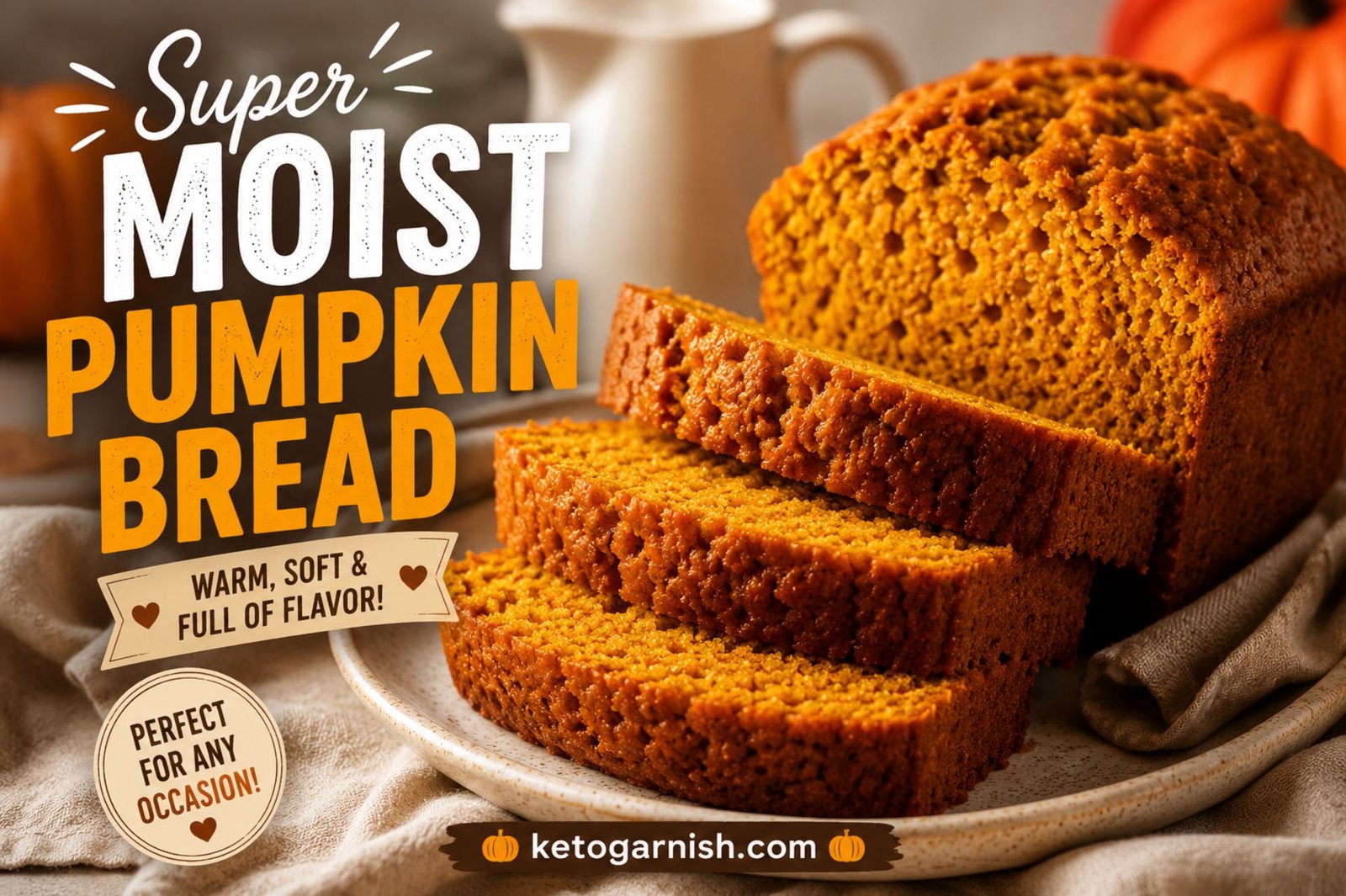
The Ultimate Super Moist Pumpkin Bread Recipe
No more dry, crumbly bricks. No more gummy, sunken centers. Just one deeply spiced, impossibly tender loaf — built on the exact reasons pumpkin bread usually goes wrong, and how to bake around every one of them.
If your pumpkin bread has ever let you down, it’s not you
Search “pumpkin bread” and you’ll find a thousand recipes that all read the same — but almost none of them explain why home ovens still turn out a dry top layer, a wet gummy seam an inch above the pan, or a loaf that caves in right down the middle. Those are the five failures that actually get typed into Google every fall. Here’s what’s really causing each one, and exactly where in this recipe it gets solved.
Dry, crumbly texture
Usually too much flour packed into the cup, or a few extra minutes past done. We fix both with the spoon-and-level method and a moisture-forward wet-to-dry ratio.
Gummy, dense center
The gluten got overworked. Once flour hits wet batter, every extra stir tightens the crumb. We stop exactly on cue in Step 5.
Sunken middle
Almost always pulled from the oven too early, or the oven door opened before the structure set. We give you a real doneness test, not just a timer.
Bland, one-note flavor
Old ground spices lose potency fast, and canned “pumpkin pie filling” is already pre-sweetened and watered down. We name the exact ingredients that fix this.
Stuck-to-the-pan disaster
Cooling too briefly, or greasing only the bottom of the pan. We show the exact prep and the 15-minute cooling window that releases it clean.
Super Moist Pumpkin Bread
One bowl, no mixer, and every measurement chosen to solve a specific failure point above. Full-fat canned pumpkin and a mix of brown and white sugar are doing most of the moisture work here — don’t swap them out.
Ingredients & quick facts
Makes 1 standard 9×5-inch loaf (10 slices)
Dry ingredients
- 1¾ cups (220g)All-purpose flour, spooned into the cup and leveled
- 1 tspBaking soda
- ½ tspBaking powder
- ½ tspFine sea salt
- 2 tspGround cinnamon
- 1 tspGround ginger
- ½ tspGround nutmeg, fresh-grated if you have it
- ¼ tspGround cloves
Wet ingredients
- 1 can (15oz/425g)Pure pumpkin puree — not pumpkin pie filling
- 1 cup (200g)Granulated sugar
- ½ cup (100g)Packed light or dark brown sugar
- ½ cup (120ml)Neutral oil or melted coconut oil
- 2 largeEggs, room temperature
- ⅓ cup (80ml)Buttermilk or plain yogurt
- 1 tspVanilla extract
- Optional ¾ cupChocolate chips, toasted pecans, or walnuts
*Calorie estimate is approximate, based on standard ingredient brands and 10 even slices — it will shift with the oil, mix-ins, and exact brands you use, so treat it as a ballpark rather than a lab measurement.
How to make it, and why each step matters
This is a real sequence — do these in order and each step quietly cancels out one of the five problems above.
Prep the pan and oven
Preheat to 350°F (175°C). Grease a 9×5-inch loaf pan on the bottom and sides, then line it with a parchment sling that hangs over the two long edges.
Fixes: the stuck-to-the-pan disaster.
Whisk the dry ingredients
In a medium bowl, whisk the flour, baking soda, baking powder, salt, and all four spices until no streaks of soda remain.
Fixes: bitter pockets from unevenly distributed leavening.
Whisk the wet ingredients
In a large bowl, whisk the pumpkin puree, both sugars, oil, eggs, buttermilk, and vanilla until fully smooth and slightly lightened in color, about 90 seconds by hand.
Fixes: bland flavor — this is where the pumpkin actually gets tasted, not buried.
Combine — and stop the second it’s smooth
Add the dry ingredients to the wet in two additions, folding gently with a spatula. Stop as soon as no dry flour streaks are visible. A few small lumps are fine and expected.
Fixes: the gummy, dense center — this is the single most important step in the recipe.
Fold in mix-ins and pour
Fold in chocolate chips or nuts if using, then pour the batter into the prepared pan and smooth the top with a spatula.
Bake 55–65 minutes
Bake until a toothpick inserted in the center comes out with a few moist crumbs clinging to it, not wet batter and not bone dry. If the top is browning fast by the 30–35 minute mark, tent loosely with foil.
Fixes: both the dry, crumbly texture and the sunken middle — this is the real doneness test.
Cool completely before slicing
Cool in the pan for 15 minutes, then lift it out by the parchment sling onto a wire rack and cool fully, about 1–1.5 hours, before slicing.
Fixes: the “wet seam” — the crumb is still setting as it cools, and slicing early releases steam that dries out every remaining slice.
The fix-it table
Already baked it and something’s off? Match what you’re seeing to the cause below — this is the exact diagnostic a professional baker runs through.
| What you’re seeing | Most likely cause | The fix, next time |
|---|---|---|
| Dry, crumbly slices | Too much flour (scooped, not spooned) or baked a few minutes too long | Spoon flour into the cup and level with a knife; start checking doneness at 55 minutes |
| Dense, gummy center | Batter was overmixed after the flour was added | Fold only until streaks disappear — stop even if a few small lumps remain |
| Sunken, caved-in middle | Pulled from the oven before the center fully set, or the door was opened early | Don’t open the oven before minute 45; use the toothpick test, not just the clock |
| Flavor tastes flat | Spices are old, or pumpkin pie filling was used instead of puree | Use pure pumpkin puree and spices under 6 months old; bump cinnamon by ½ tsp if needed |
| Bread won’t release from the pan | Pan wasn’t fully greased, or bread was removed while still warm and fragile | Grease sides and bottom, line with parchment, and cool 15 minutes before unmolding |
| Top is dark, inside still wet | Oven runs hot, or rack was positioned too high | Tent with foil at 30–35 minutes and bake on the center rack |
Six small habits that make a real difference
Spoon, don’t scoopScooping flour straight from the bag can pack in up to 20% more than a recipe intends — the single biggest cause of dry bread.
Check the can“100% Pure Pumpkin” and “Pumpkin Pie Filling” are not the same product — the filling is pre-sweetened and spiced, and will throw off both texture and flavor.
Room-temperature eggsCold eggs seize the oil and stop the batter from emulsifying smoothly, which bakes unevenly.
Stop stirring earlyThe moment flour disappears into the batter, put the spatula down. Every extra stroke tightens the crumb.
Tent, don’t panicA dark top with a wet center just means airflow needs blocking, not a lower oven temperature.
Patience on the cool-downThe crumb is still setting for the first hour out of the oven — slicing early is the #1 reason a “moist” loaf turns gummy on the plate.
Five ways to change it up
Chocolate chip & pecan
Fold in ¾ cup chocolate chips and ½ cup toasted, chopped pecans in Step 5.
Cream cheese swirl
Beat 4oz cream cheese with 2 tbsp sugar and 1 egg yolk; dollop over the batter and swirl with a knife before baking.
Streusel-topped
Mix ⅓ cup flour, ⅓ cup brown sugar, and 3 tbsp cold butter into crumbs; scatter over the batter before baking.
Gluten-free
Swap in a 1:1 gluten-free flour blend that contains xanthan gum — no other changes needed.
Muffins or mini loaves
Same batter, 18–22 minutes for muffins or 35–40 minutes for mini loaves, at the same oven temperature.
How to store it so it stays moist
Wrap tightly in plastic wrap or foil once fully cooled, and keep at room temperature.
Wrap well; bring slices to room temperature or warm 10 seconds before eating for the best texture.
Slice first, wrap each slice individually, then freeze in a bag. Thaw at room temperature in about an hour.
See the whole process in real time
If you’d rather watch the fold-until-just-combined moment than read about it, here’s the technique in motion.
Frequently asked questions
Can I use fresh pumpkin instead of canned?
Why is my pumpkin bread dense or gummy in the middle?
Why did my loaf sink in the middle?
Can I turn this into muffins?
How do I keep it moist for longer?
Why isn’t my bread very orange?
Can I reduce the sugar?
Is pumpkin bread actually a bread, or a cake?
One loaf, zero guesswork
Every measurement and every step above exists to cancel out a specific reason pumpkin bread goes wrong. Follow it once, and you’ll know exactly why it works — which means you’ll never need to search “why is my pumpkin bread dry” again.
Back to the recipe